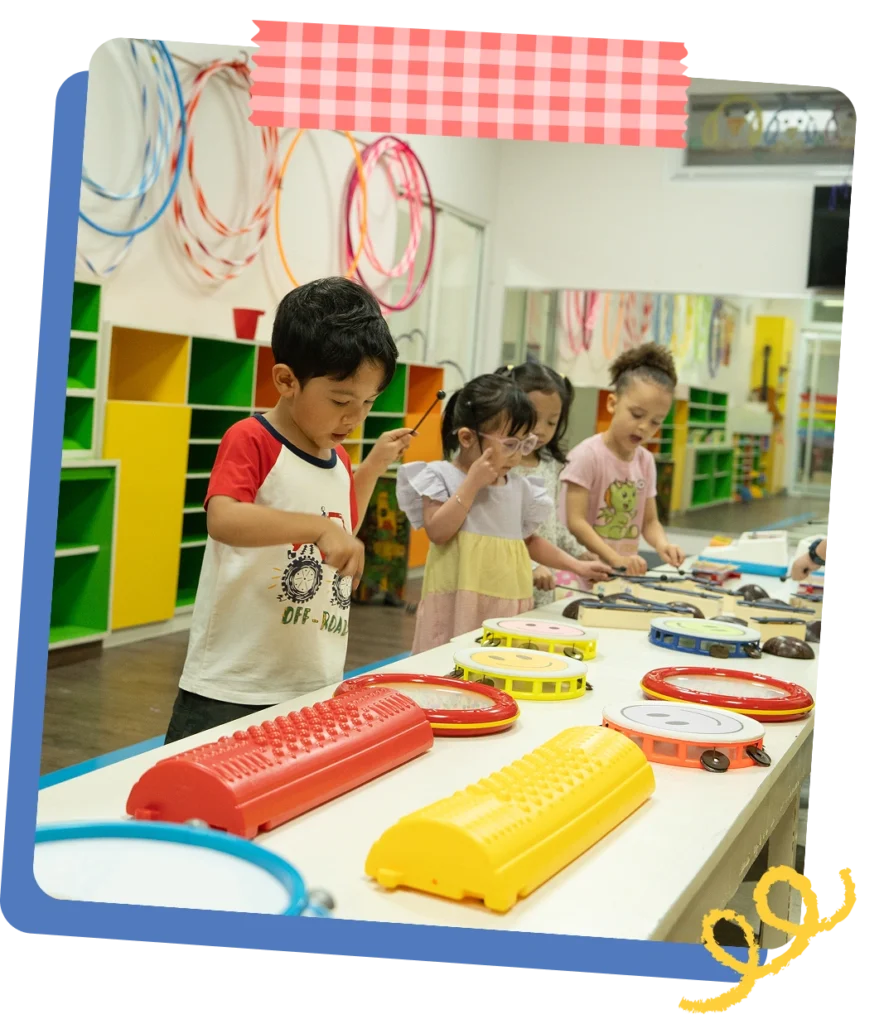
Every day includes Music & Movement and time in the indoor playground.
Children move between focused work, movement, and play with purpose.
They shift naturally between independent work and shared activity.
Each day brings a different focus, allowing children to explore one area at a time and deepen their understanding across the week.
Music & Movement also changes each day, with varied activities that build expression, rhythm, and coordination.
Each part of the day is carefully prepared to support how children learn.
Early Years (1–4½ Years)
Foundations through exploration and experience
Nursery (1–2½ Years)
Gummi
Care
Junior Kinder
(2½–3½ Years)
Teddy
Panda
Senior Kinder 1
(3½–4½ Years)
Polar
Nursery (1–2½ Years)
Discovery begins through the senses.
Nursery (1–2½ Years)
Discovery begins through the senses.
Children explore the world through touch, movement, sound, and repetition.
What you will see:
hands-on materials across tables
children moving freely between activities
music and movement throughout the day
Tables are prepared with different materials so children can work side by side, moving toward what draws their attention.
Learning unfolds through experience and repetition. Early foundations for language, coordination, and curiosity begin here.
Junior Kinder (2½–3½ Years)
Meaning begins to take shape.
Junior Kinder (2½–3½ Years)
Meaning begins to take shape.
Exploration becomes more focused.
What you will see:
children working together around shared materials
early writing beginning to emerge
number frames and counters in use
Children sit longer and work more closely together. Activities unfold around shared materials, with each child contributing in their own way. Being part of the group begins to matter.
They use number frames and move counters, beginning to see and feel quantity as early writing emerges.
And then comes the joyful moment. “I did it.”
Senior Kinder 1 (3½–4½ Years)
Ideas begin to hold.
Senior Kinder 1 (3½–4½ Years)
Ideas begin to hold.
Children think with greater intention.
What you will see:
children staying longer with their work
conversations forming around shared ideas
early phonics through sound and visuals
They stay with their work, testing ideas and seeing them through. Working together becomes part of learning.
They count and group, beginning to see value. Patterns make sense. Numbers start to hold meaning.
Phonics develops through visual sound cues as children learn to hear and connect sounds.
Friendships grow stronger, and learning to be a friend becomes part of the day.
DepEd Kindergarten & Primary (4½–7½ Years)
Structured learning with growing independence
Senior Kindergarten 2
(4½–5½ Years)
Prep
Primary 1
(5½–6½ Years)
Whiz 1
Primary 2
(6½–7½ Years)
Whiz 2
Senior Kinder 2 (4½–5½ Years)
Learning takes shape.
Junior Kinder (2½–3½ Years)
Meaning begins to take shape.
Understanding begins to come together.
What you will see:
clear learning steps
concepts experienced in different ways
early penmanship through design
Through simple experiences, children begin to understand how things work before putting them into writing.
Penmanship begins to shift. Strokes turn into designs. Lines and curves carry color and story.
Children become more aware of one another. Friendships deepen as they learn how to work and play together.
Primary 1 (5½–6½ Years)
Language finds its voice.
Primary 1 (5½–6½ Years)
Language finds its voice.
Children begin to use language with greater ownership.
What you will see:
storytelling through loose parts
learning shaped by shared ideas
first steps in writing their ideas
Verbs are introduced through movement and action, often brought to life through superhero play.
Children build storyboards before turning ideas into words, forming the Superhero Comic Book Project.
Writing develops step by step as ideas become visible and concrete.
Partner work becomes part of the routine as children collaborate and develop ideas together.
Their ideas begin to take shape through both speech and writing.
Primary 2 (6½–7½ Years)
Thinking begins to lead.
Primary 2 (6½–7½ Years)
Thinking begins to lead.
Children approach their work with growing independence.
What you will see:
collaborative problem-solving
structured projects
independent thinking emerging
Ideas take shape through discussion and shared problem-solving. Materials are arranged, tested, and refined. Patterns and symmetry begin to guide thinking.
Children contribute more confidently, work thoughtfully with others, and carry their ideas with greater independence.
Learning becomes more deliberate, as children take greater ownership of their work.
A Program You Can Trust
For over 40 years, Creative Play Corner has guided children through their early years with care and clarity.
Recognized by the Department of Education. Built on experience and refined over time.
School Year & Program Structure
The school year is organized into three terms, each lasting approximately 12 weeks, followed by a shorter summer program of 7 to 8 weeks.
The summer program continues the flow of learning, often with its own distinctive theme.
This structure allows children to stay engaged and build on their understanding throughout the year.
Visit
See how this approach comes to life in the classroom.